



Spotting Rare Designer Accessories: Expert Guide for Collectors
BVPRIVE Editorial Team on 10th Apr 2026
Spotting Rare Designer Accessories: Expert Guide for Collectors
TL;DR:
- True rarity in designer accessories comes from limited production, exotic materials, and provenance.
- Proper authentication requires specific tools, knowledge, and professional verification to avoid costly errors.
- Provenance and trusted sources are essential for assessing value and building a lasting, valuable collection.
Rare designer accessories occupy a singular position in the luxury market: they carry cultural weight, signal refined taste, and quietly build wealth over time. Yet even seasoned collectors make costly errors when evaluating a piece’s true rarity. A Hermès Birkin in a standard colorway and one crafted from Himalayan crocodile leather may look similar at a glance, but their value trajectories are worlds apart. This guide walks you through every critical step, from understanding what genuine rarity means to authenticating with professional-grade precision, so you can make confident, informed acquisitions that stand the test of time.
Table of Contents
- What makes a designer accessory truly rare?
- Essential tools and prerequisites before authenticating
- Step-by-step process to spot authentic rarity
- Verifying rarity and protecting your investment
- A collector’s insight: Why provenance and trusted sources matter most
- Upgrade your collection with BVPRIVE expertise
- Frequently asked questions
Key Takeaways
| Point | Details |
|---|---|
| Provenance is essential | Accessories with verified histories consistently command more value and appreciation than those with unclear origins. |
| Authenticate beyond appearance | Advanced fakes mimic looks but fail close inspection of materials, serials, and production logic. |
| Professional verification pays | Third-party services and auction houses offer accuracy that protects your investment and peace of mind. |
| Preparation avoids costly mistakes | Gather all tools and knowledge upfront to spot red flags and confirm rarity. |
What makes a designer accessory truly rare?
Now that we’ve established why identifying rarity matters, let’s break down what sets rare accessories apart from the rest.
True rarity in designer accessories is not simply about age or price. It emerges from a precise combination of factors: limited production runs, discontinued model lines, unique brand collaborations, and the use of exotic or restricted materials such as Himalayan crocodile, shagreen, or meteorite dials on timepieces. A piece produced in a run of 50 carries an entirely different market position than one produced in 5,000, even if both carry the same label.
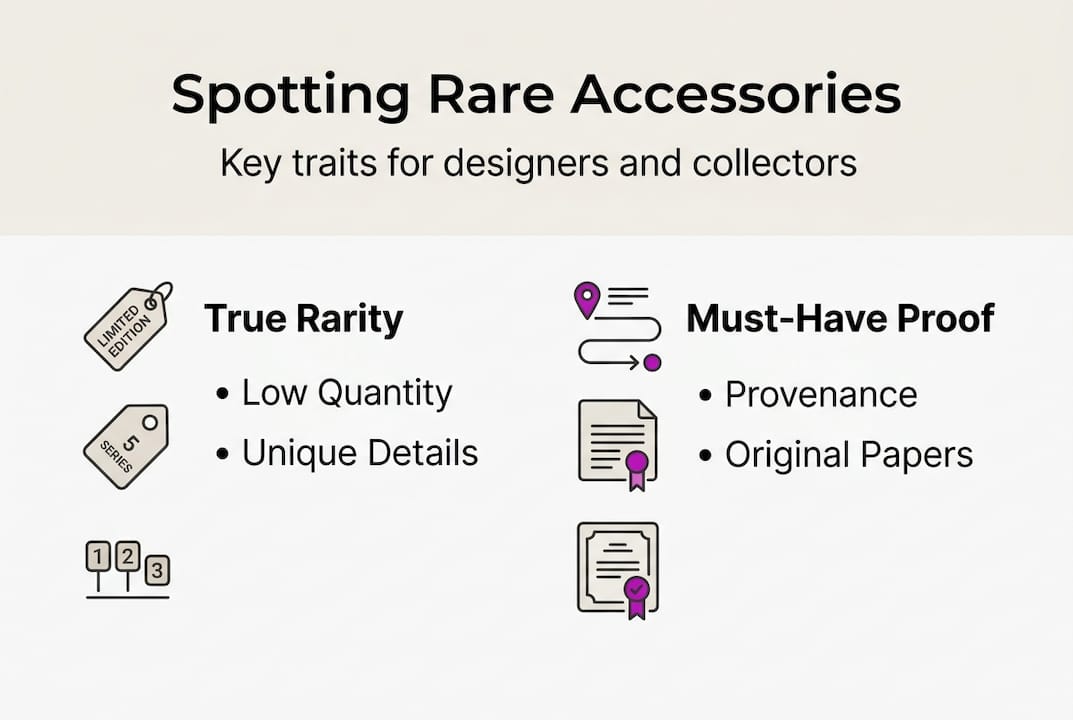
Documented provenance, meaning the verified history of ownership and accompanying papers, elevates a piece further. Original receipts, certificates of authenticity, and dust bags from the year of purchase tell a story of tradition that a bare item simply cannot. Condition and natural patina also matter enormously. A well-aged piece with consistent, even wear often commands more respect than one that appears artificially preserved.
Cultural moments drive demand in ways that surprise even experienced buyers. A bag carried by a celebrated figure at a landmark event can see its value multiply within months. Investing in rare accessories requires understanding these cultural currents, not just catalog specifications.
Top 5 factors that affect accessory rarity:
- Limited or numbered production run
- Exotic or restricted material (crocodile, ostrich, lizard)
- Documented provenance with original paperwork
- Discontinued model or unique collaboration
- Cultural significance tied to a specific moment or figure
| Attribute | Rare accessory | Common accessory |
|---|---|---|
| Production volume | Under 200 units | Thousands annually |
| Material | Exotic leather or precious metal | Standard calf or canvas |
| Provenance | Full documentation | Minimal or none |
| Model status | Discontinued or special edition | Current catalog item |
| Resale trajectory | Appreciating | Stable or depreciating |
The numbers reinforce this reality. Rare handbags appreciate 14% annually, with Birkin and Himalaya examples regularly exceeding $100,000 at auction, driven by rarity, provenance, and condition. Understanding limited edition investment value is therefore not optional for serious collectors. It is the foundation of every smart acquisition.
Essential tools and prerequisites before authenticating
Understanding what makes something rare is just the start; having the right resources and mindset is essential before authenticating.
Approaching an authentication without proper preparation is one of the most common mistakes collectors make. The right tools sharpen your perception and reduce the risk of overlooking critical details under pressure.
Prerequisites before any hands-on examination:
- A clean, well-lit workspace (natural light reveals color inconsistencies best)
- Brand-specific knowledge: serial number formats, hardware finishes, and stitching standards by era
- Access to historic price and reference data from trusted auction records
- Original purchase documentation or any available provenance paperwork
- A calibrated digital scale for hardware and chain weight checks
| Tool | Role in authentication |
|---|---|
| 10x loupe magnifier | Reveals stitching quality, engraving depth, and material texture |
| UV light | Exposes hidden stamps, repairs, and dye inconsistencies |
| Digital scale | Measures hardware and chain weight against known standards |
| Serial number guide | Cross-references production codes by brand and year |
| Certificate of authenticity | Confirms factory origin and material specification |
| Reference image archive | Provides visual benchmarks for comparison |
To identify rarity beyond authenticity, experts recommend verifying limited editions through production history, checking for discontinued styles and unique collaborations, and confirming provenance through original receipts and certificates. Condition and patina consistent with the piece’s stated age are equally important signals.
Pro Tip: Build a digital archive of serial number patterns and brand production timelines organized by year. Cross-referencing a serial against this archive takes seconds and can immediately flag a mismatch that would take a novice hours to notice.
Before you touch the piece, research matters as much as inspection. Resources on authenticating luxury bags and understanding signs of a genuine designer bag will sharpen your baseline before the physical evaluation begins.

Step-by-step process to spot authentic rarity
With your preparation in place, here’s how to systematically evaluate an accessory for true rarity.
Step 1: Verify the model and production history. Cross-reference the exact model name, colorway, and hardware finish against brand archives. Confirm whether the configuration was produced in limited numbers or as part of a special series.
Step 2: Inspect serial numbers and date codes. Each major brand uses distinct serial formats that changed over specific periods. A Chanel piece from before 1986, for example, carries no hologram sticker at all. Mismatched formats are an immediate red flag.
Step 3: Examine materials under magnification. Genuine exotic leathers show natural scale variation and irregular pore patterns. Embossed fakes display uniform, mechanical repetition. Run your fingertip across the surface: authentic crocodile has a subtle give and warmth that synthetic materials cannot replicate.
Step 4: Test construction and hardware. Count stitches per centimeter and check alignment at seams. Hardware on genuine pieces carries precise engraving depth. Use your scale to weigh chains and closures against documented standards.
Step 5: Apply advanced sensory checks. Weight, density, and even odor reveal what visual inspection misses. Vintage items require era-specific checks, and superfakes often fail on leather behavior, chain weight, and odor profile. For jewelry, micro-tolerances and density testing expose even high-quality counterfeits.
Pro Tip: Authentic leather has a distinctive, natural scent that no synthetic can fully replicate. A chain on a genuine Chanel bag has a specific weight and drape. Train your hands and nose alongside your eyes.
Warning: Counterfeiters are now using real gold hardware and high-quality exotic leathers in their productions. Standard visual checks alone are no longer sufficient for high-value pieces. Advanced sensory and density testing is now essential.
For a deeper look at spotting rare designer bags and spotting fake designer bags, these resources extend the process with brand-specific detail.
Verifying rarity and protecting your investment
After your initial checks, don’t rely solely on your own assessment. Protect your investment with professional verification.
Self-assessment is a strong starting point, but the stakes at the top of the market demand a second opinion. Professional verification services exist precisely because the cost of a mistake far exceeds the cost of the service.
Top third-party verification services:
- Entrupy: AI-powered authentication with 99.1% accuracy for handbags and accessories
- The RealReal: In-house authentication labs staffed by brand-trained specialists
- Sotheby’s and Christie’s: Full provenance documentation for high-value auction submissions
- Rebag: Rapid digital authentication with condition grading
| Verification method | Cost | Accuracy | Speed |
|---|---|---|---|
| DIY inspection | Free | Moderate | Immediate |
| Entrupy AI scan | $25 to $50 per item | 99.1% | Same day |
| RealReal lab review | Included with consignment | Very high | 1 to 3 days |
| Auction house review | Varies | Highest | 1 to 2 weeks |
Reading a certificate of authenticity correctly is its own skill. Look for specific material descriptions, production codes, and issuing authority signatures. Generic or vague language is a warning sign regardless of how official the document appears.
Preserving value after acquisition requires equal attention. Store pieces in climate-controlled environments away from direct sunlight. Insure high-value accessories with a specialist luxury insurer, not a standard home contents policy. When the time comes to sell, choose channels that attract verified buyers: established auction houses, reputable resellers, or platforms with built-in authentication. Reviewing the value of limited edition handbags and using an authentication checklist for collectors before any transaction protects both your asset and your reputation as a collector.
A collector’s insight: Why provenance and trusted sources matter most
Ultimately, the most successful collectors think differently. Here is what experience in the luxury market consistently reveals.
Chasing a bargain without provenance almost always backfires. Even an ultra-realistic counterfeit, one that passes a casual visual inspection, holds zero value the moment its origins are questioned. The collector who saves 30% by skipping provenance verification risks losing 100% of their investment. That is not a trade-off worth making.
Only accessories with well-documented histories appreciate reliably over time. Documented history elevates value beyond mere authenticity, transforming a beautiful object into a lasting legacy asset. Trusted auction houses and verified resellers offer a level of peace of mind that no private sale can match, because their reputation depends on getting it right every time.
Provenance is not paperwork. It is the narrative that makes rarity real. Understanding why authenticity matters in this context shifts your perspective from buyer to custodian, and that shift is what separates collectors who build lasting portfolios from those who accumulate expensive regrets.
Upgrade your collection with BVPRIVE expertise
If you’re ready to put your new expertise to work, take the next step with a trusted resource.
At BVPRIVE, every piece in the curated collection has been meticulously verified for authenticity and rarity. The platform specializes in Hermès, Chanel, Louis Vuitton, and other elite brands, offering rare and limited-edition accessories with full provenance documentation and tax-free worldwide delivery.
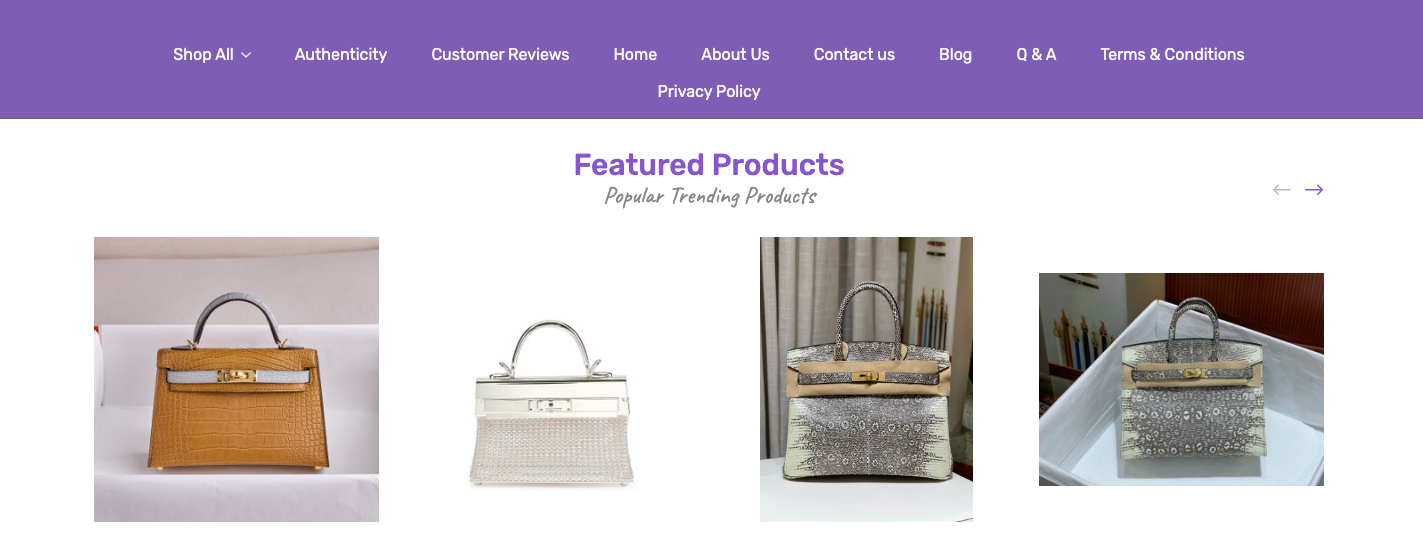
Whether you want to browse new arrivals, connect with a VIP personal shopping specialist, or explore the rare accessory investment advantages that define the current market, BVPRIVE provides the expertise and inventory that serious collectors rely on. Your next exceptional piece is waiting.
Frequently asked questions
What is the single best way to spot a rare designer accessory?
Check for a combination of documented provenance, unique production history, and verified limited series rather than relying on serials alone. Rarity requires verifying limited editions through production history, discontinued styles, unique collaborations, and cultural significance.
Is it worth paying for professional verification?
Yes. AI authentication tools like Entrupy and auction house documentation significantly reduce risk and increase resale value, making the cost of verification a sound investment for any serious collector.
What is the most common mistake collectors make?
Buying rare-looking pieces without provenance or expert authentication, which exposes them to high-quality counterfeits and permanent loss of value. Trusted channels and documented history are the only reliable safeguard.
Which brands produce the rarest designer accessories?
Hermès (Birkin, Himalaya), Chanel, and Cartier consistently top rare accessory lists, particularly in limited or discontinued runs. Birkin and Himalaya examples regularly exceed $100,000 at auction, reflecting their unmatched rarity and demand.